
Published newsletter
Article Details
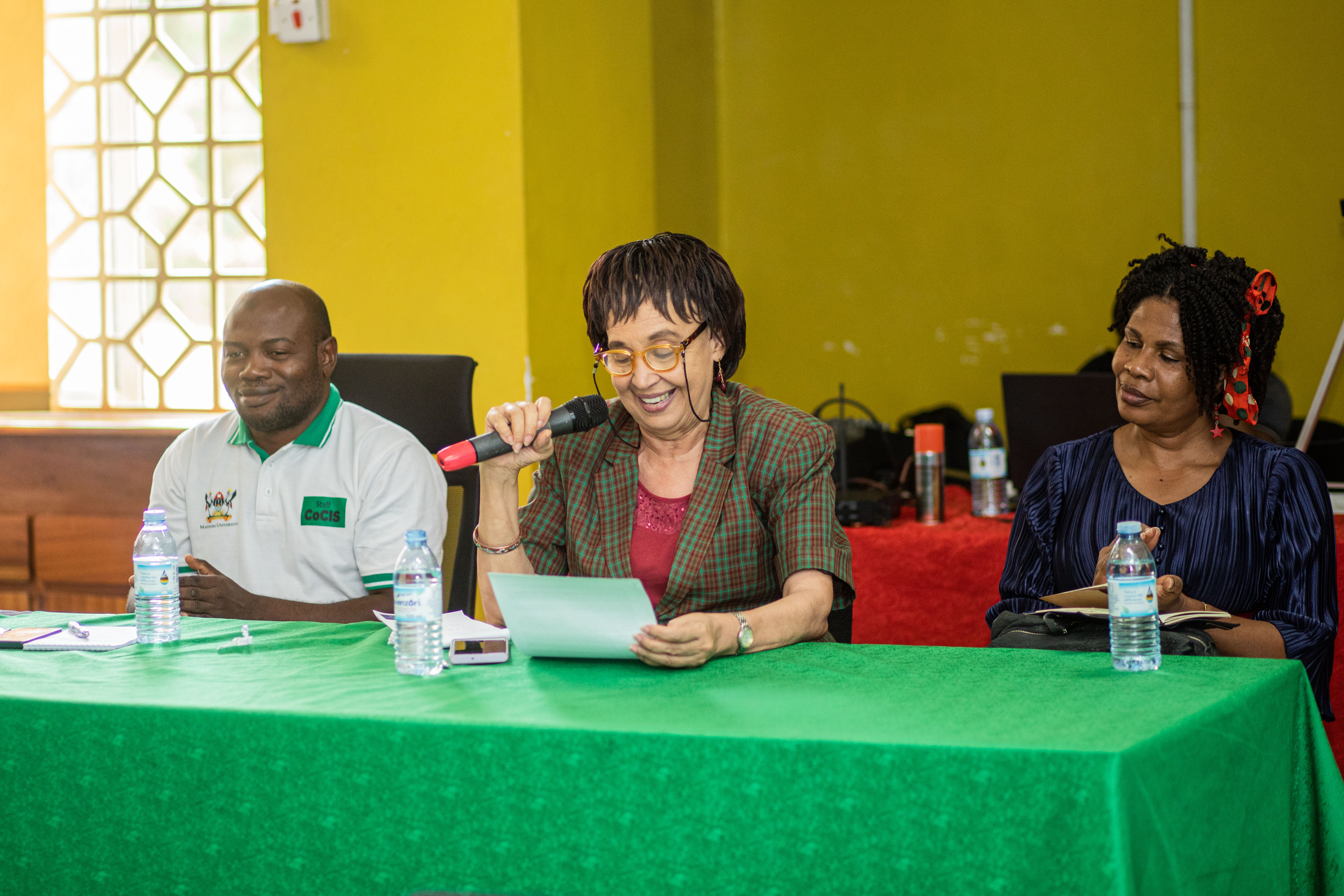
Distinguished business leader and farmer Professor Margie Kigozi has urged researchers to prioritise affordability, security and practical usability as smart agricultural technologies move closer to deployment. Speaking as Chief Guest at the five-year review meeting of the AdEMNIA Project, Professor Kigozi praised the innovation demonstrated by researchers working on smart beekeeping systems and fruit fly control technologies, describing the work as a powerful example of how science can address Africa’s real agricultural challenges.
Drawing from her experience as a former leader at the Uganda Investment Authority, and as proprietor of the Zuri Model Farm, she highlighted the twin pressures farmers face: managing pests while maintaining productivity. With over 6,000 mango trees, coffee plantations and beekeeping operations on her farm, she noted that fruit flies remain one of the most destructive threats to mango production, often forcing farmers to abandon organic methods due to severe infestations.
She welcomed the newly developed smart bee monitoring system using IoT-enabled sensors, which allows farmers to supervise hives remotely, saying it would greatly improve hive security, honey yields and disease management, especially for farmers managing distant apiaries. She also commended the locally developed fruit fly trap, calling it a vital solution to a problem that costs farmers and exporters millions in losses every year.
However, Professor Kigozi cautioned that cost remains the biggest barrier to adoption, particularly for smallholder farmers. She urged researchers to continue working on reducing production costs and exploring shared infrastructure models, such as solar power systems serving multiple units. She also raised concerns over equipment security on remote farms, calling for low-cost but effective safeguards to prevent theft and vandalism.
Importantly, she offered her own farm as a testing site for field trials, emphasising the need to move innovations from the laboratory into real farming conditions. She also encouraged the inclusion of electricity-powered options for farmers already connected to the national grid.
Beyond the technologies themselves, Professor Kigozi applauded the project’s collaborative model, which brings together universities, government agencies, industry partners and young researchers from institutions such as Makerere University, Dar es Salaam Institute of Technology, the University of Juba, and NTNU.
She called for a strong focus on scaling, inclusivity and sustainability, ensuring that women, youth and smallholder farmers benefit from these innovations. She congratulated the project team on five years of progress and urged them to continue transforming research into real-world agricultural solutions.